

-
Image

Knee pain and knee osteoarthritis
- Knee pain isn't always knee osteoarthritis
- Causes of knee pain
- What is knee osteoarthritis?
- Signs of knee osteoarthritis
- Causes of knee osteoarthritis
- Who is at risk of knee osteoarthritis?
- How to check your knees yourself
- How to treat and relieve knee pain: artificial joint fluid injections
- How to treat and relieve knee pain: physical therapy
- Tips to reduce knee pain
- Pain treatment without medication or surgery at Rehab Care Clinic
Knee pain isn't always knee osteoarthritis
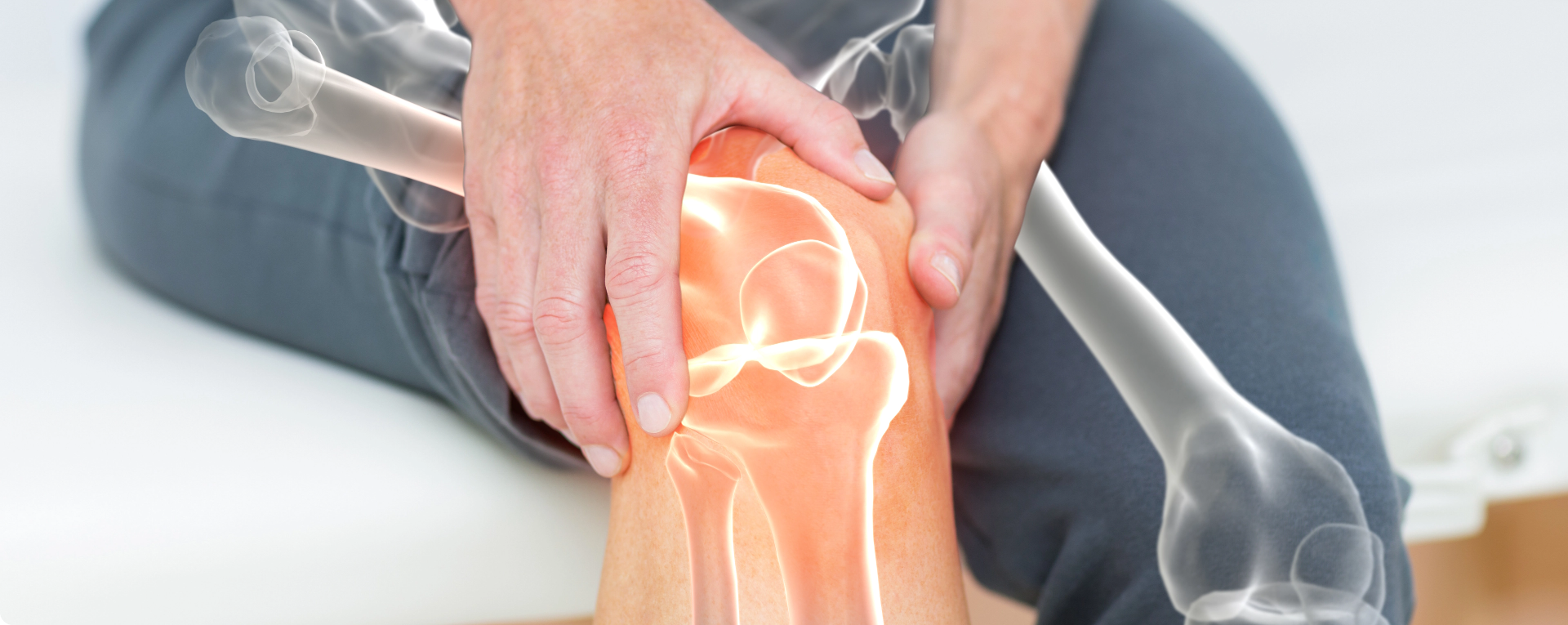
Knee pain is a common problem at every age, from teenagers and working adults to older people. It has many possible causes, from overuse injuries to chronic joint diseases. In this article, we look at the various conditions associated with knee pain, their causes and how to treat them.
Causes of knee pain
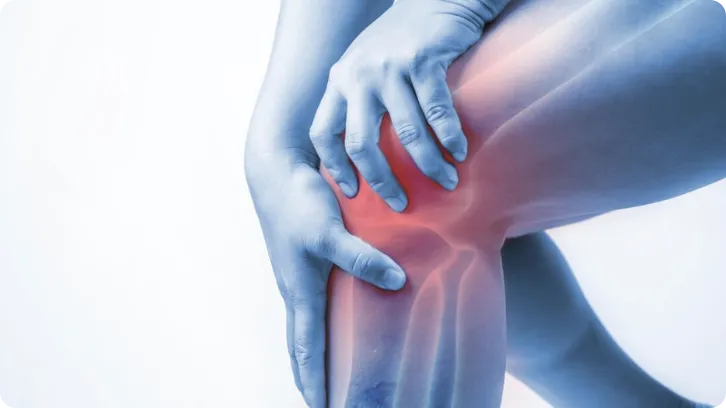
Knee pain can be caused by many factors, including:
1. Injuries leading to conditions affecting the ligaments, tendons, menisci and bursae
1.1. Torn or overstretched ligaments and tendons, often caused by sport or seen in athletes who rely heavily on their knees
- Anterior cruciate ligament tear (ACL tear): pain, swelling, a loose knee joint and a feeling that the knee is unstable
- Patellar tendinitis (jumper's knee): pain at the front of the knee, especially when going up and down stairs
- Iliotibial band syndrome (ITB syndrome): pain on the outer side of the knee, especially when running or going down stairs
1.2. Meniscus tear : caused by sudden twisting or rotation of the knee, with knee pain, swelling and locking of the knee
1.3. Patellar dislocation : the kneecap moves out of its normal position, causing severe pain, swelling and inability to move the knee
1.4 Baker's cyst : occurs when the knee produces more synovial fluid than the body needs, so the fluid collects at the back of the knee and forms a swollen lump. Common causes are related to joint problems such as knee injury, structural problems inside the knee or knee arthritis. Symptoms usually include tightness and pain behind the knee, especially when straightening the knee or walking, being unable to bend the knee fully, and a soft lump or cyst that can be felt behind the knee.
2. Degenerative and inflammatory joint diseases
2.1. Knee osteoarthritis (OA) A condition in which the cartilage of the knee joint gradually wears away, common in older people and those who have used their knees heavily over a long period. Symptoms: knee pain, joint stiffness and a crackling sound in the knee.
2.2. Rheumatoid arthritis (RA) An autoimmune disease that causes chronic joint inflammation, leading to swollen, inflamed joints and long-term joint damage. Symptoms: knee pain, swollen joints, morning stiffness and possibly fatigue.
2.3. Gout Caused by a build-up of uric acid in the joint, leading to acute inflammation. It usually affects the big toe joint, but the knee can also be affected. Symptoms: severe pain, swelling, redness and heat in the knee.
2.4. Septic arthritis Caused by a bacterial, viral or fungal infection in the knee joint. This is an emergency that needs prompt treatment. Symptoms: severe knee pain, swelling, redness and fever.
3. Diseases of the bones and knee structure
3.1. Osteoporosis Makes the bones fragile and prone to fractures. Symptoms: chronic knee pain and possibly fractures without realising it.
3.2. Osteomyelitis An infection of the bone that may spread to the knee joint. Symptoms: pain, swelling, redness and possibly a high fever.
4. Lifestyle and other factors
- Being overweight, which increases the load on the knee joints
- Overexercising or playing sport too intensely
- Walking or standing for long periods
- Unsuitable footwear, such as high heels or shoes without shock absorption
Knee pain has many causes. It may result from various diseases and conditions affecting the joints, bones, ligaments, tendons or tissues around the knee, not just osteoarthritis. So how can you tell what is causing your knee pain and whether it is osteoarthritis? Let's take a closer look at knee osteoarthritis.

Pain treatment without medication or surgery
at Rehab Care Clinic
Rehab Care Clinic, a specialist rehabilitation medicine and physical therapy clinic,
is committed to providing high-quality, high-standard care
to give you a stronger body and a better quality of life.
"Dedicated to caring for every kind of pain, with doctors and physical therapists,
modern equipment and service from the heart."
What is knee osteoarthritis?
Knee osteoarthritis is another common problem in older people and those who have used their knees heavily for a long time. It occurs when the articular cartilage of the knee loses its ability to absorb shock and becomes less elastic. Combined with weak thigh muscles, this means the knee absorbs more impact than normal, so the bones of the joint rub against each other during movement and wear down, leaving the joint surface thin and uneven. If it becomes chronic, the bone tries to repair itself and forms rough bone spurs inside the joint, making movement stiff and possibly causing noises in the joint. If left untreated or undiagnosed by a doctor, it can lead to severe knee inflammation.
Signs of knee osteoarthritis
- Knee pain or twinges in the knee
- Joint stiffness, usually after waking up, lasting no more than 30 minutes and improving after moving around for a while
- A crackling sound in the knee when moving
- Reduced range of motion
- Joint swelling in some cases
- Joint deformity, usually after a long time
Causes of knee osteoarthritis
- Ageing, which causes age-related wear of the cartilage surface
- Excess body weight, which increases the load on the knees
- Use, postures and activities that speed up knee degeneration, such as kneeling, sitting with legs folded to the side, sitting cross-legged, or frequently climbing up and down stairs, all of which put a lot of pressure on the knees; also athletes who jump, land hard or twist their knees, and marathon runners who use their knees continuously for long periods
- A previous direct injury to the knee or knee surgery, which speeds up knee osteoarthritis
Who is at risk of knee osteoarthritis?
- Older people, usually aged 50 and over
- Women more than men
- People who are overweight (BMI > 23)
- People who have had a knee injury
- People with weak thigh muscles
- People who use their knees a lot, for example by frequently squatting or kneeling
- People with other types of arthritis, such as gout or rheumatoid arthritis
How to check your knees yourself
- Walking pattern: in severe cases, the legs bow outwards and you avoid putting full weight on the painful leg
- Joint swelling or deformity: when there is inflammation inside the knee, the knee swells and feels warmer than normal
- Muscle wasting: the front thigh muscle on the painful side is thinner than on the other leg
- Tender points: usually on the inner side of the knee or around the knee
- Range of motion: the knee cannot move through its full range
- A crackling sound in the knee when moving
If you have knee pain and want to know whether your knee joint is degenerating, you can be examined and diagnosed by a specialist. At Rehab Care Clinic, our doctors use diagnostic ultrasound to look for abnormalities. Ultrasound diagnosis is a technology that improves the detail of diagnosis and detects abnormalities of the bones, joints and muscles with high accuracy and precision. Patients can see the abnormality on the ultrasound screen straight away, which helps them understand their condition better.
Pain treatment without medication or surgery
at Rehab Care Clinic
Rehab Care Clinic, a specialist rehabilitation medicine and physical therapy clinic,
is committed to providing high-quality, high-standard care
to give you a stronger body and a better quality of life.
"Dedicated to caring for every kind of pain, with doctors and physical therapists,
modern equipment and service from the heart."
How to treat and relieve knee pain: artificial joint fluid injections
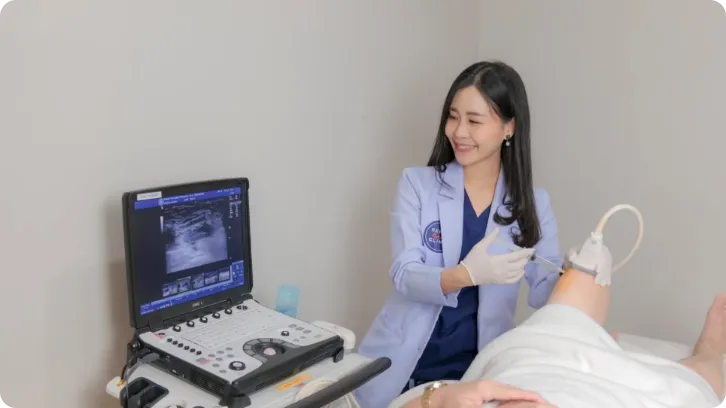
An artificial joint fluid injection involves injecting a gel-like fluid called hyaluronic acid into the knee joint. It acts as a lubricant, reduces friction and works as a shock absorber to cushion impact during movement, easing pain and stiffness in the joint. At Rehab Care Clinic, the specialist uses ultrasound to guide the injection so that it reaches the exact problem spot accurately, reducing the risk of hitting a nerve.
How to treat and relieve knee pain: physical therapy
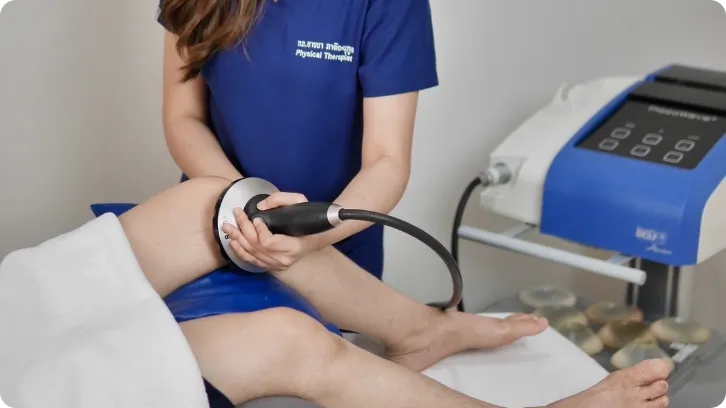
Physical therapy works very well when combined with artificial joint fluid injections and helps reduce pain. The physical therapist uses focused shockwave on the muscles around the knee to stimulate repair and reduce pain; this also helps reduce knee inflammation without medication. The physical therapist uses high-power laser therapy to energise sore or inflamed cells, relieving inflammation and helping the body repair itself faster. We also give self-care advice and design personalised exercises.
Tips to reduce knee pain
- Avoid sitting with legs folded to the side, kneeling or squatting
- Apply a hot compress for 30 minutes in the morning and evening
- Losing weight reduces the load on your knees and also slows knee degeneration
- Use knee supports to help stabilise the knee and prevent injury
- Take supplements that help strengthen bones and joints
- Choose suitable exercise, such as water exercise or yoga
Because the knees work hard and absorb impact all the time, they are prone to pain and inflammation. Keeping your knees strong is therefore important to reduce the risk of knee problems. If you have followed the advice in this article and are not getting better, we recommend consulting a specialist promptly for an examination and diagnosis, so that a precise, targeted and suitable treatment plan can be made.
Pain treatment without drugs or surgery at Rehab Care Clinic
Pain treatment without drugs or surgery
at Rehab Care Clinic
Rehab Care Clinic is a specialist rehabilitation medicine and physical therapy clinic dedicated to high-quality, high-standard care, helping you to a stronger body and a better quality of life.
Contact a branch
-
Phetkasem
-
Rama 2
-
Muang Thong Thani
-
Ratchada
-
Sathorn
- Johns Hopkins Medicine. (2023). Understanding Knee Joint Anatomy and Disorders. Retrieved from https://www.hopkinsmedicine.org
- American Academy of Orthopaedic Surgeons. (2023). Knee Pain and Common Knee Problems. Retrieved from https://www.aaos.org
- Mayo Clinic. (2023). Baker’s Cyst, Prepatellar Bursitis, and Iliotibial Band Syndrome. Retrieved from https://www.mayoclinic.org
- National Health Service. (2023). Knee pain and its management. Retrieved from https://www.nhs.uk
- Arthritis Foundation. (2023). Arthritis and Knee Health: Causes, Symptoms, and Treatments. Retrieved from https://www.arthritis.org
- Harvard Medical School. (2023). Preventing Knee Pain and Managing Osteoarthritis. Retrieved from https://www.health.harvard.edu