
How to breathe for stronger lungs
#WhyBreathingNeedsTraining #StrongLungsStartWithBreathing
COVID-19 is a disease that directly affects the respiratory system, and even after recovery it can leave lesions in the form of fibrosis and scarring in the lungs. This reduces lung function, causing short, shallow breathing or an inability to breathe fully, and you may tire easily.
People infected with COVID-19, especially those who also have pneumonia, should therefore receive appropriate breathing training alongside their treatment to help improve breathing efficiency and air circulation within the lungs, as well as to help with coughing and clearing phlegm. Here are some basic breathing exercises that anyone can do, not just patients.
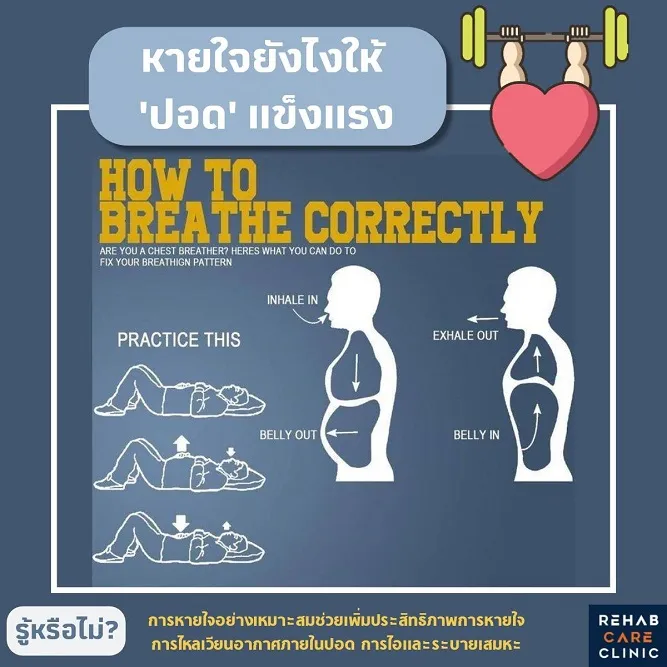
Diaphragmatic breathing
Get into a relaxed position; lying flat or lying on your back with your head raised at about 45 degrees is recommended. Place your hand on your abdomen and focus on your breathing. Breathe in through your nose so that your abdomen rises, then slowly breathe out through your mouth so that your abdomen falls. Avoid lifting your chest when breathing in, as this uses the wrong muscles for breathing. Repeat 5–10 times. You can practise every 1–2 hours.
Lower rib expansion breathing
Get into a relaxed position; lying flat or lying on your back with your head raised at about 45 degrees is recommended. Place your hands on both sides of your lower ribs. Breathe in through your nose so that your lower ribs push your hands outwards as far as possible, then breathe out normally. Repeat 5–10 times. You can practise every 1–2 hours.
Precautions
- If you experience breathlessness, chest pain, dizziness or palpitations that do not go away after resting, see a doctor immediately.
- Breathing exercises should be done in sets with rest breaks in between to prevent dizziness during the exercises.

Information provided by
Dr. Apiporn Garnjanagoonchorn (Dr. Ann)
Rehabilitation physician