
Why does my back hurt when I'm just sitting?
Many people wonder why they get back pain when they are just sitting and not doing anything. Today Rehab Care Clinic explains why, along with some ways to fix it.
First, let's get to know the key components of the back. Between the vertebrae of the spine sit jelly-like intervertebral discs, which help bear weight, absorb pressure from above and allow us to bend forwards or arch backwards smoothly. But when the pressure on the back increases, especially from sitting in poor postures or lifting heavy objects, too much force is transferred to the discs. If this happens repeatedly, the discs can be damaged, for example by degenerating faster than normal, bulging (bulging) or slipping out (herniation) beyond the line of the spine. This may compress nearby nerves, leading to back pain, pain radiating down the leg, or numbness along the nerve.
The spine is also surrounded by back muscles that support it. When pressure on a disc increases to the point that the disc becomes inflamed, the muscles around the back tighten, which can also cause back pain.
Image: Comparison of the load on the intervertebral discs in different postures
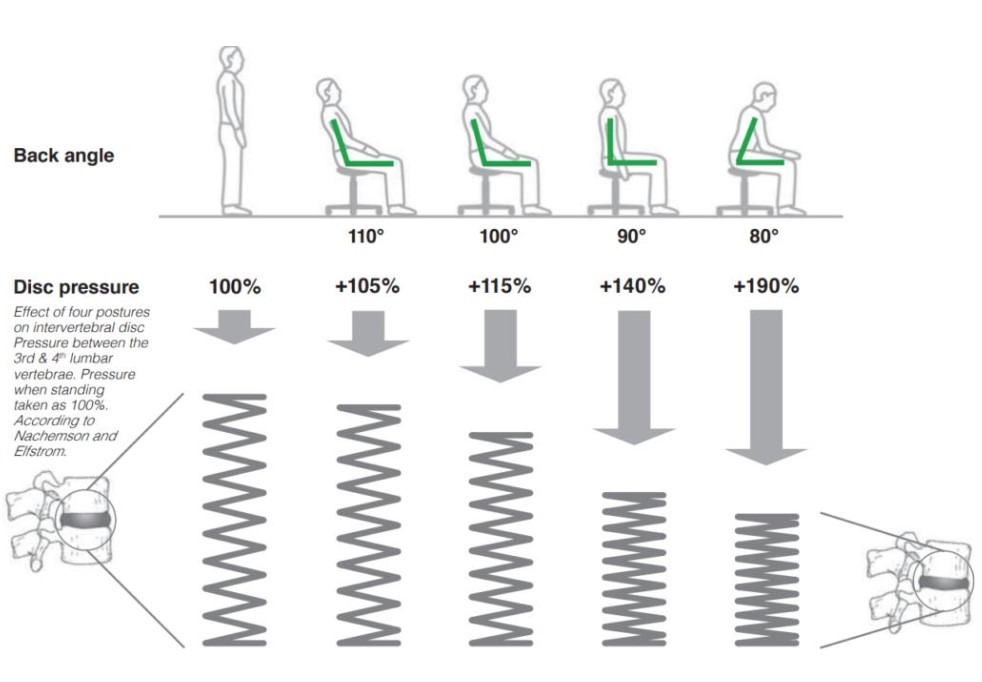
The image shows that the pressure on the intervertebral discs differs from one posture to another. Sitting puts more load on the discs than standing, and the more you lean forward while sitting, the greater the load on the discs. When the pressure is high enough to inflame the discs, the muscles around the back tighten and cause pain. This explains why people who sit for long periods get back pain.
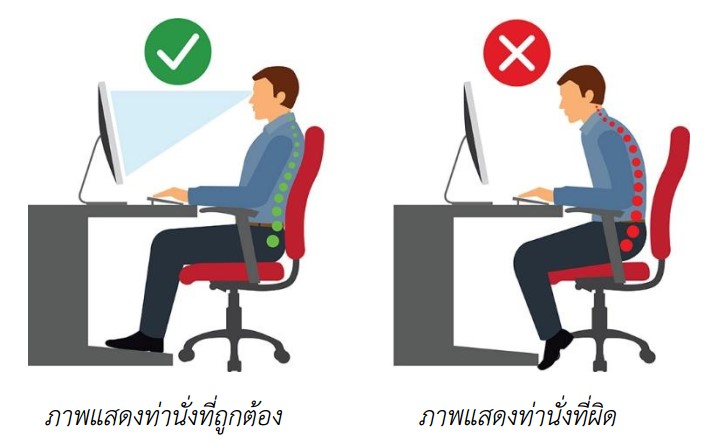
Another cause of back pain is sitting in poor postures, such as slouching, crossing your legs, leaning to one side, or sitting with your weight unevenly distributed. This makes the muscles work incorrectly or work hard for long periods until they become inflamed, resulting in back pain. If you keep repeating the same habits, the back pain can become chronic.
How to relieve back pain from sitting for long periods
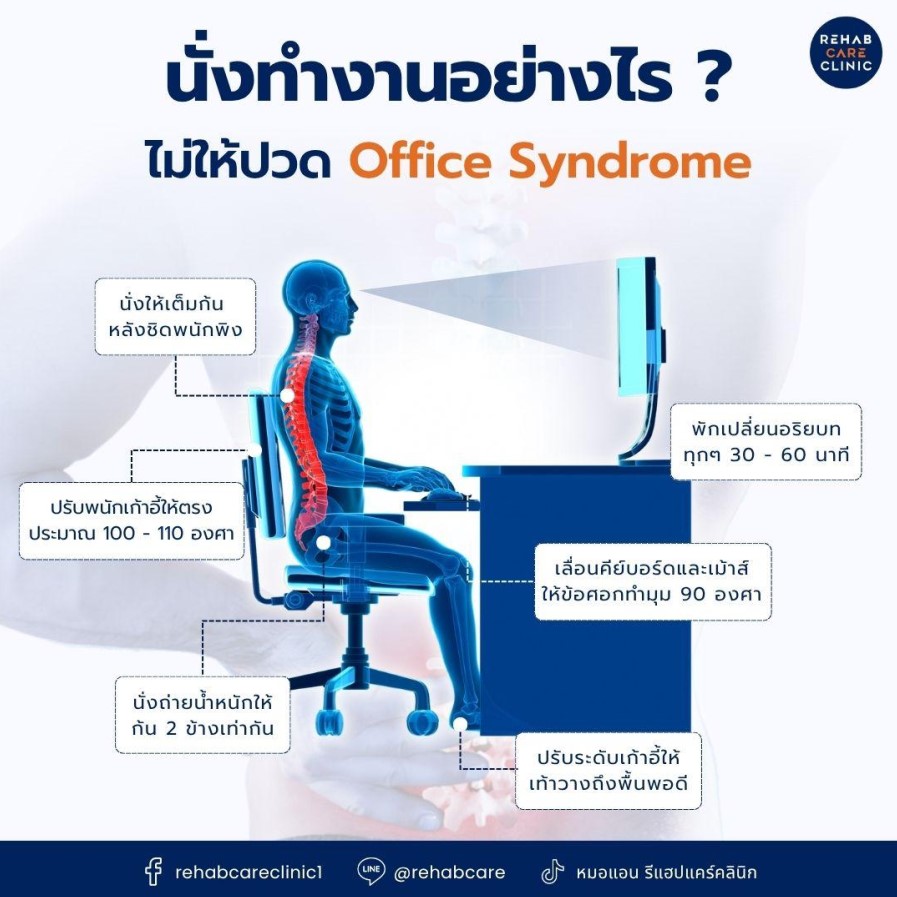
1. Change the way you sit
The correct sitting posture is to sit up straight with your weight evenly balanced, and not to stay in any one position for long. Change position every hour, and if you have to work at a computer for long periods, adjust your seating and desk according to ergonomic principles (Ergonomic) to reduce the strain on your muscles.
2. Exercise your muscles regularly
Exercises to reduce back pain from prolonged sitting should focus mainly on the lower back and hip muscles. They fall into 2 types: stretching and strengthening. The exercises are as follows.
Stretching
(Hold each stretch for 10–20 seconds, repeat 5–10 times, 3 sessions a day)
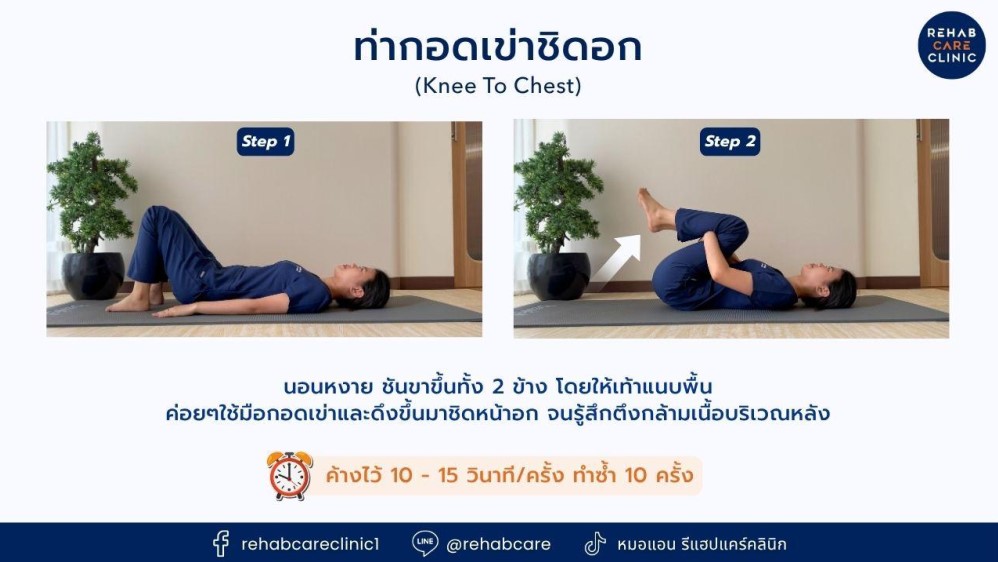
1. Lower back stretch: lie on your back and bring both knees up to your chest, using your hands to pull on the backs of your thighs to stretch as far as you can without feeling pain. Hold the position.
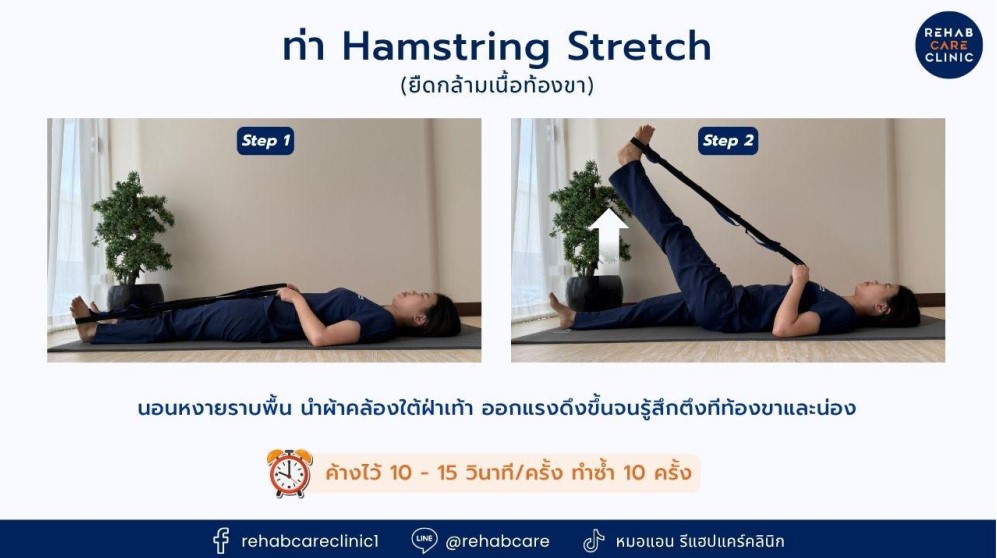
2. Hamstring stretches to stretch the back of the thigh, a muscle that often becomes tight when we sit for long periods. Lie flat on your back with both knees bent and your feet flat on the floor. Loop a towel under one foot, straighten the knee and pull the towel until you feel a stretch in the back of your thigh and calf. Hold for 10–15 seconds. Repeat 10 times on each side.
Strengthening
(10 repetitions per set, 3–5 sets a day)
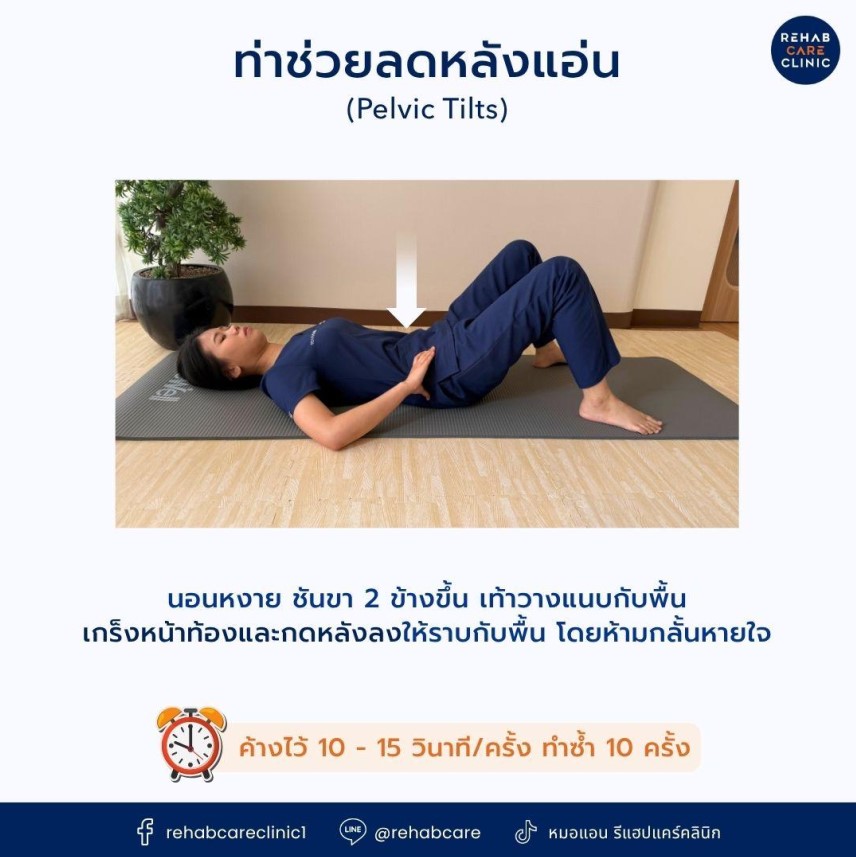
1. Back strengthening exercise: lie on your back with both knees bent, then breathe in and out slowly while drawing in your stomach, pressing your lower back into the bed and tightening your buttock muscles. Hold for a count of 1–10, then slowly relax.
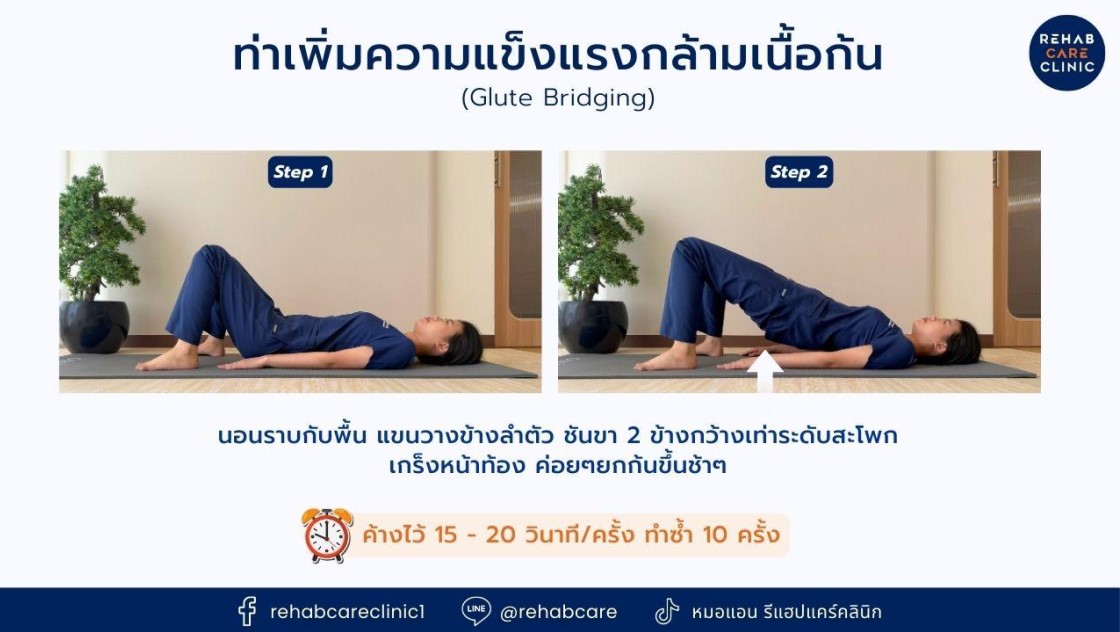
2. Hip strengthening exercise: lie on your back with both knees bent, then lift your hips and hold them up, tightening the muscles, for a count of 1–10, then slowly lower your hips.
3. Physical therapy using physical therapy equipment to relieve pain and relax the muscles at the affected spot, for people whose pain is severe enough to disrupt daily life and who cannot do the exercises above. In these cases equipment is needed to relieve the pain first. Recommended equipment for relieving pain and relaxing muscles includes focused shockwave therapy (Focus shockwave), peripheral magnetic stimulation (PMS) and high-power laser therapy (High power laser), as well as warm compresses, which you can also do yourself at home.
If you have further questions or would like advice about back pain, please get in touch. The clinic has rehabilitation physicians and physical therapists to advise you on back pain and on suitable care and treatment.
Interested in a consultation? Contact us on LINE: @rehabcare
Or call: Phetkasem branch 061-801-2482, Rama 2 branch 062-773-1113, Muang Thong Thani branch 061-394-6762, Rama 9 branch 061-732-3113, Sathorn branch 062-215-6086
Siriwan Yongyut (Ke), PT
Reference
https://www.slideshare.net/UtaiSukviwatsirikul/1-36399145
https://www.si.mahidol.ac.th/th/division/hph/admin/news_fles/326_49_1.pdf
https://w2.med.cmu.ac.th/northo/p/knowledge-for-the-people/1771/

Information provided by
Dr. Apiporn Garnjanagoonchorn (Dr. Ann)
Rehabilitation physician