

How to sit when driving to avoid back pain

The main problem for car drivers is back pain. Long distances are not the obstacle; it is fatigue that puts many people off long drives. If you use your car a lot and drive often, the aches may build up more and more, because the body does not like staying in one position for a long time. It is even worse if that position does not suit the body's natural alignment, for example bending the head forward too much or rounding the back too much. On top of that, eye strain gradually builds up tension and contributes to muscle stiffness. All of these things happen while driving, so we need to start by correcting our body posture.
When we drive, there are several adjustable features in the car, such as the side mirrors, the rear-view mirror, the seat and the steering wheel. These may not need adjusting often if only one person uses the car, but they should still be set appropriately and checked every time before driving, following the principles below.
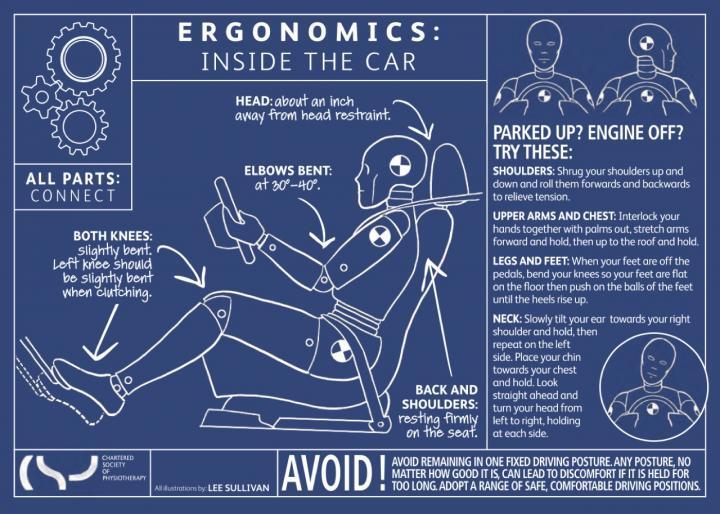
1. Adjust your seating distance
- Sit with your bottom right back in the seat and your back flat against the backrest.
- Keep your neck straight, at an angle of about 15 degrees to the backrest.
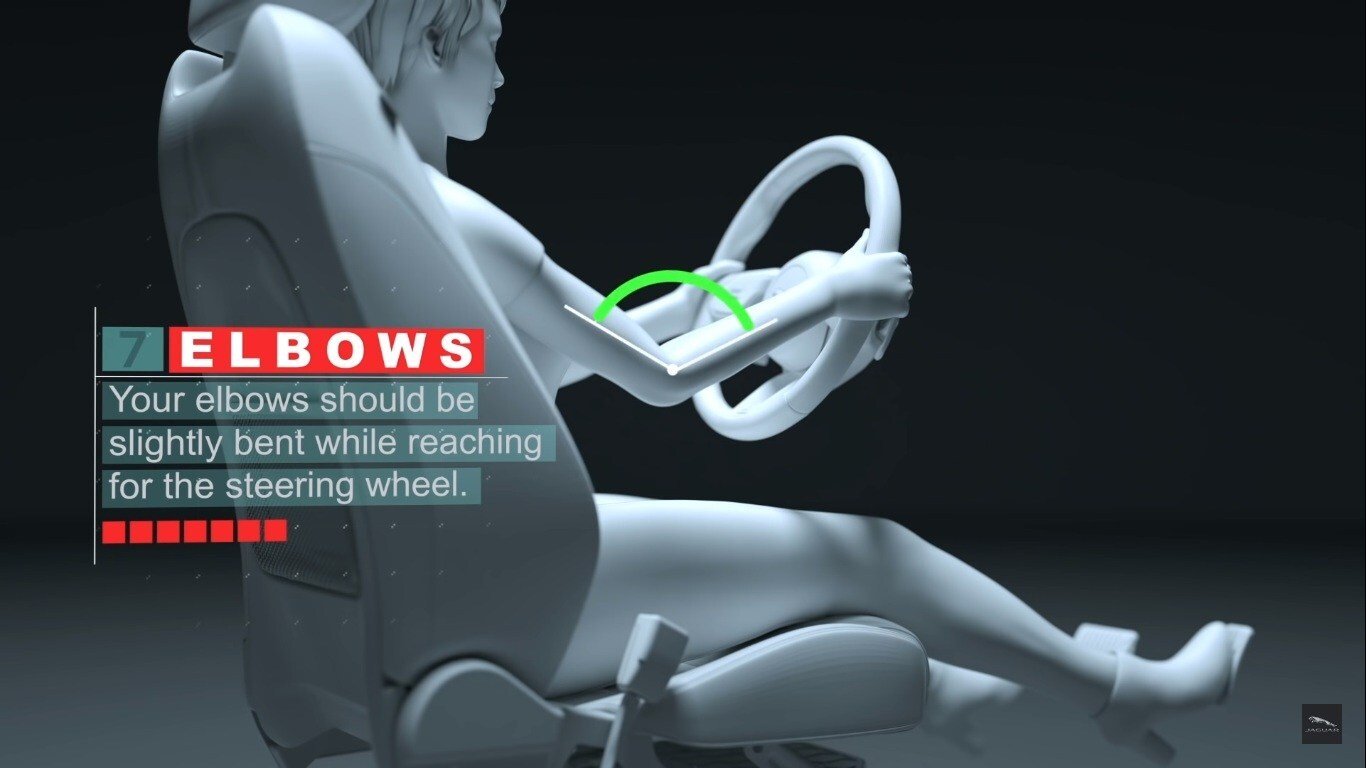
- Let your arms and shoulders relax. When holding the steering wheel, your elbows should be at an angle of 90–115 degrees and no more than 120 degrees, depending on what feels comfortable.
- Slide the seat so that your knees are bent, but not too much. Bending the knees and hips too much makes it difficult to flex your ankles, so you have to lift your leg to move your foot between pedals. On the other hand, straightening your legs too much puts your body and legs in an L shape, which also affects braking and accelerating: you have less force because you can only press with the tip of your foot and cannot use power from the knee and hip.
2. Adjust the backrest angle
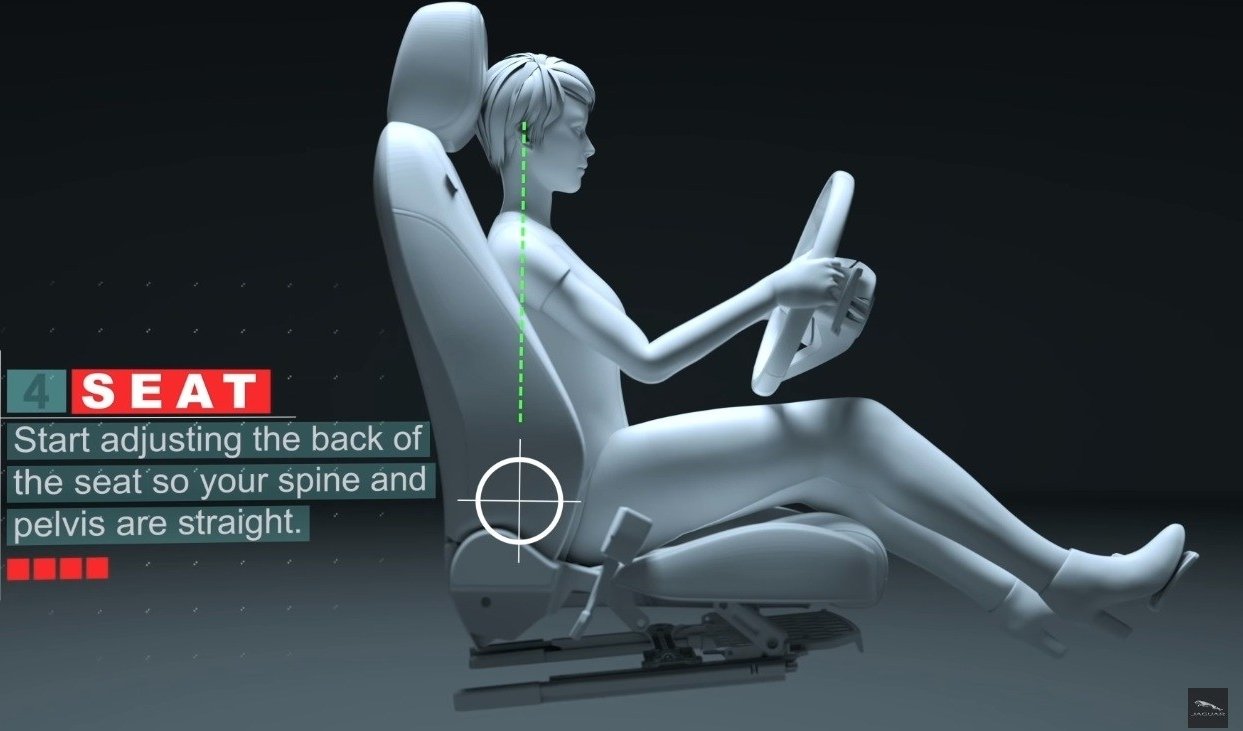
- Once your legs are positioned correctly, your body may be too far back, so you need to raise the backrest more upright. Raising the backrest may put your back and legs in an L shape as in point 1, but sitting upright has the advantage that you do not need to bend your neck much, so your shoulders and neck do not get tired.
- The backrest should be tilted so that, when driving, you do not feel you need effort to lift your neck and head upright.
- Adjust the lumbar support so that you feel even pressure along your lower back (if your seat has no lumbar support, you can use a small cushion behind your lower back instead).
3. Adjust the seat height
- Set the seat so that there is one fist's width between your head and the car roof. This alone will help prevent back pain and give you good visibility.
4. Adjust the steering wheel angle
- A steering wheel set higher than is natural for your body makes your neck and shoulders tense, and also makes the car harder to control, as you have to reach and shift position at times.
- Adjust the steering wheel to a position where you can hold it comfortably for long periods, with your hands at the 3 o'clock and 9 o'clock positions.
- The right distance and height is one where, with your hands in place, you can turn the wheel easily without any restriction or feeling that you need to reach. At the same time, your shoulder muscles should not have to tense up to keep your arms on the wheel for long periods.
5. Adjust the side and rear-view mirrors
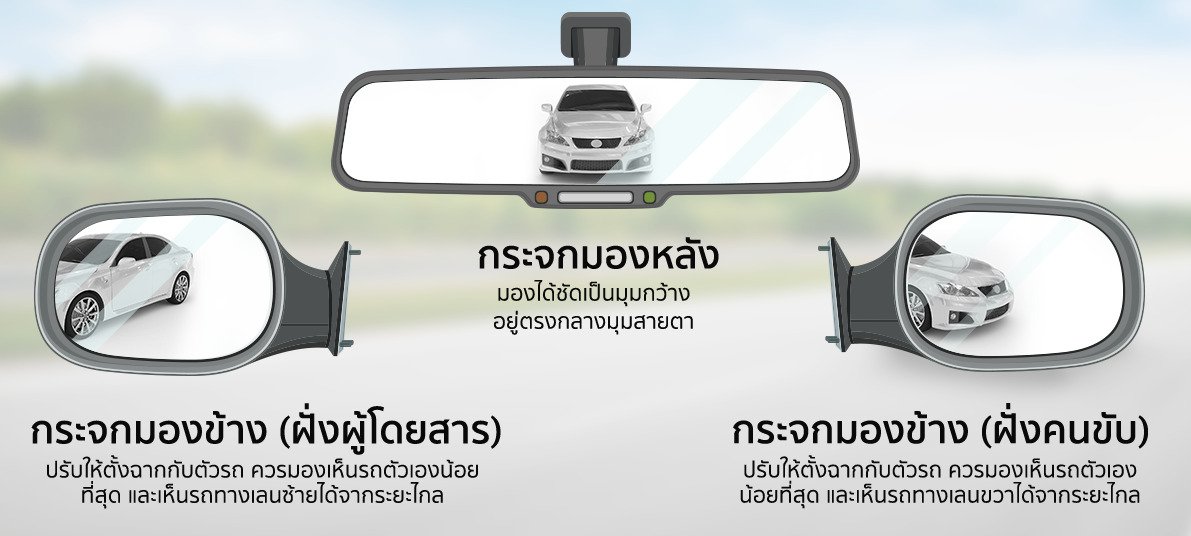
- The principle is that, when seated, you can see everything you need without moving your head or leaning your body.
6. Headrest
- When you lean fully back against the seat and the back of your head touches the headrest, the seat is in a suitable and safe position.
- If, when you lean back, the headrest comfortably supports the nape of your neck, the seat is set too low. To use the headrest for its real purpose, adjust the seat so that the headrest supports your skull, not the nape of your neck.
All of these principles must also put driving safety first. An adjustment that is comfortable but unsafe is not a good adjustment. Make adjustments only when the car is stationary, never while it is moving, especially sliding the seat or changing the backrest angle, which could be dangerous while driving. And as mentioned, the body does not like staying in one position for long. Even if you have a good sitting posture and a seat that suits you, your body still needs to change position.
So take frequent breaks on long drives. Get out of the car, stretch and wash your face to relieve fatigue and tension. If you do this, you will enjoy driving more.
For more information, contact "Rehab Care Clinic"
Address: 423 Phetkasem Road, Bang Wa, Phasi Charoen, Bangkok (inside Kanari Sports Center, before Seacon Bangkae) ? 061-801-2482 Line ID: @rehabcare

Information provided by
Dr. Apiporn Garnjanagoonchorn (Dr. Ann)
Rehabilitation physician