
What does pain in the sole of the foot have to do with flat feet?

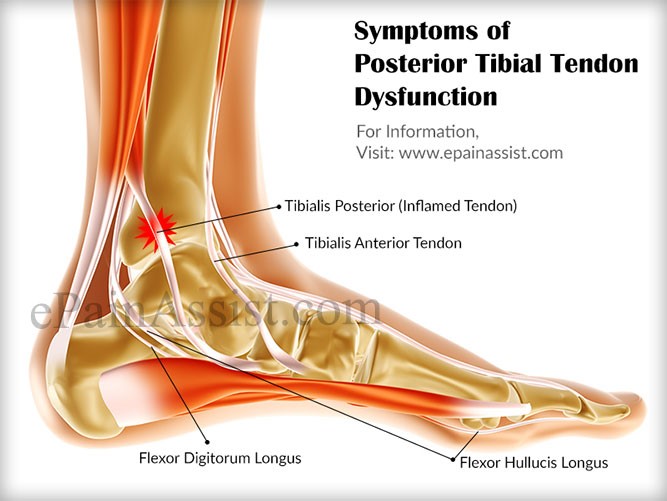
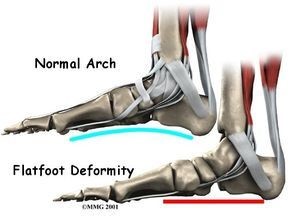
A 49-year-old Thai man came to us with pain in the sole of his right foot and tenderness below the inner ankle bone of the right foot for about 5 months. The pain got worse when he put weight on the foot, for example when standing or walking. His history showed that his job involved standing and walking all the time.
Physical examination of this patient found
1. Flat feet, with the right foot flatter than the left.
2. Swelling from inflammation around the Tibialis posterior tendon.
3. Increased pain when moving the foot upwards, pointing it downwards, turning it inwards and turning it outwards.
4. Tender points below the inner ankle bone of the right foot and along the inner shin.
This patient may have had Tibialis posterior tendon pain first, which then led to flat feet. The main functions of this muscle and tendon are to point the foot downwards (plantar flexion) and turn the heel inwards (inversion). The muscle also has the important role of acting as a dynamic stabiliser (Dynamic stabilizer) of the arch, keeping the arch raised. But when this muscle is injured and cannot work fully, the arch flattens, and when the patient walks and puts weight on the foot
while the tendon is still injured, the front of the foot swings outwards (forefoot abduction), the heel tilts outwards (hindfoot valgus) and the talus bone tilts inwards. As a result, the inner arch disappears and the weight lands in the wrong place, stretching the tendon further, so the patient continues to have pain.
Physical therapy treatment
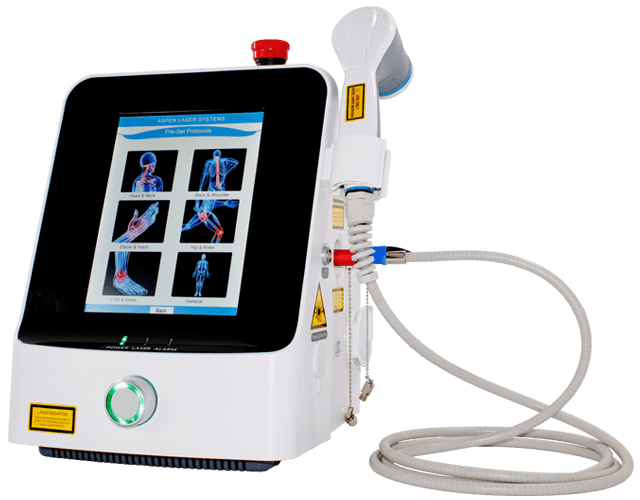
- High laser power
- TENS electrical stimulation for pain relief
- Ultrasound
- Stretching & Exercise
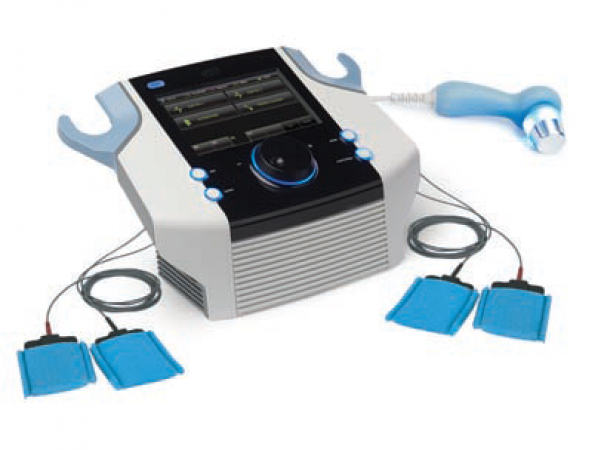
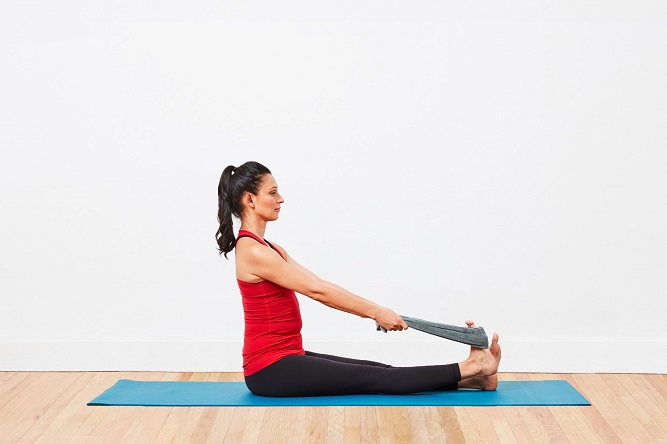
Exercises
1. Sit with a towel looped around the sole of your foot and pull it towards you. Hold for a count of 15 seconds and repeat 5 times.
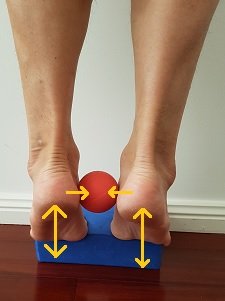
2. Stand and rise up onto your toes and back down while squeezing a small ball between your heels.
If this is painful, do it sitting down instead. 10–15 repetitions per set, 3 sets.
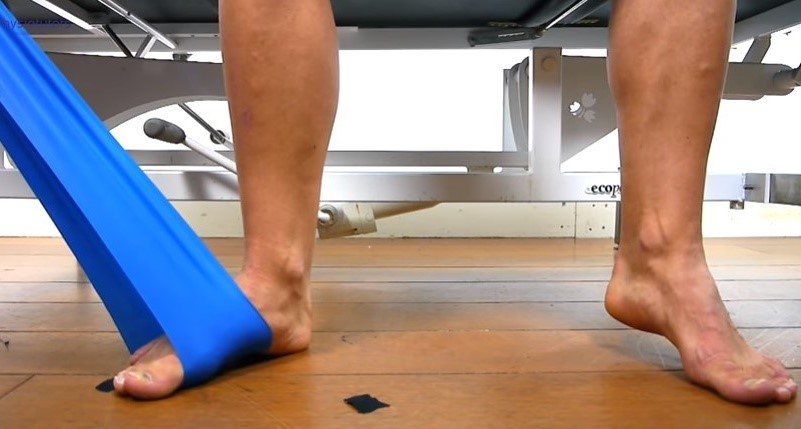
3. Sit with your foot on the floor and a resistance band pulling it outwards.
Turn the sole of your foot back inwards against the band. 10–15 repetitions per set, 3 sets.
Self-care
As well as exercise, choosing the right shoes or insoles is important to support weight-bearing on the existing flat-foot structure, so that the foot and leg muscles work correctly and long-term problems are prevented.
How are flat feet classified?
A simple test for flat feet is called the Jack Test.
How to do the test: lift both big toes.
1. If an arch appears when you lift them, as in the picture, this is flexible flat foot (Functional Flatfoot).
2. If no arch appears when you lift them, as in the picture, this is structural flat foot (Nonfunctional Flatfoot).
Types of flat feet and treatment
1. Structural flat foot (Nonfunctional Flatfoot )
Wearing shoes with arch support will cause injury. Treatment options are surgery and choosing shoes with a wide, soft and comfortable sole.
2. Flexible flat foot (Functional Flatfoot )
Choose shoes with built-in arch support. As a treatment, custom insoles can be made for the individual patient to support the foot bones and the arch, and to realign the angles of the bones, foot muscles, Achilles tendon and calf muscles into a straight line. This keeps the ankle aligned when standing or walking, and if worn regularly, the insoles can help restore the arch and allow the related muscles to work properly.
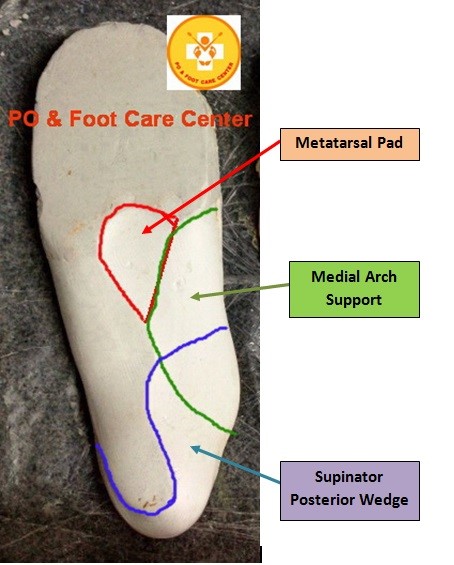
Insoles for people with flat feet
1. Metatarsal pad to offload the ball of the foot (Metatarsal Pad)
Because most people with flat feet have a flattened arch and a walking pattern in which the weight-bearing line falls further to the inside than normal, the 1st to 3rd metatarsal heads (1st – 3rd Metatarsal Head) bear more weight than normal. Adding a metatarsal pad (Metatarsal Pad) reduces the force on the ball of the foot and spreads it to the middle of the foot bones (neck and shaft of Metatarsal Bones).
2. Medial arch support (Medial Arch Support)
This supports the arch muscles and the normal bony structure of the foot, and prevents the arch from collapsing inwards when standing and walking.
3. Medial heel wedge to tilt the heel back to a normal angle (Supinator Posterior Wedge)
This corrects and prevents the heel bone from tilting inwards, which is the main cause of flat feet and abnormal foot alignment, by lifting the inner side of the heel bone.

Information provided by
Dr. Apiporn Garnjanagoonchorn (Dr. Ann)
Rehabilitation physician