What is focused shockwave therapy?
#7PopularShockwaveQuestions #WhatToKnowAndContraindicationsBeforeShockwave
Before having physical therapy, you should ask your physical therapist about the devices used and any contraindications, for your safety and the best treatment results. Today let's get to know focused shockwave therapy.
1. Did you know that shockwave therapy can break down calcium deposits?
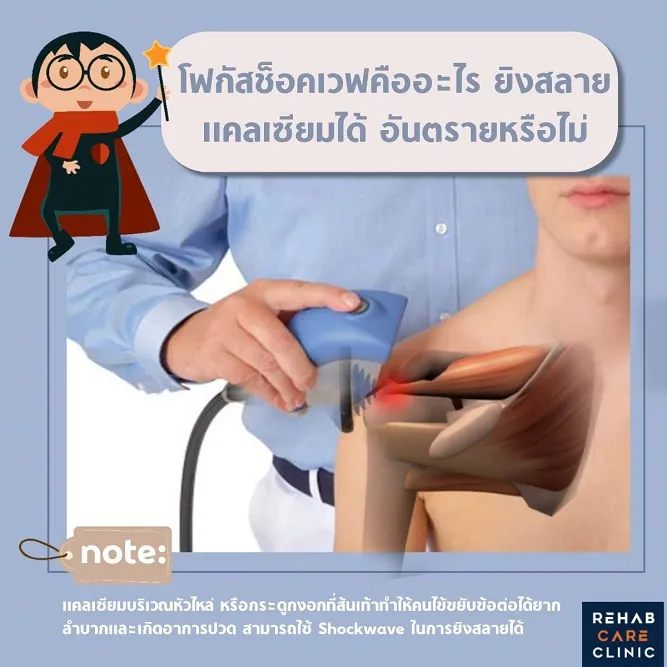
Focused shockwave therapy is a modern treatment innovation that helps break down calcium deposits that form in our joints. Calcium deposits around the joints make them harder to move and also cause pain. Research by R Cosentino et al. in 2003 found that the energy released by focused shockwave therapy strikes the calcium deposits in the joints, breaking them up and reducing their size. In some cases, the calcium deposits disappear completely, which reduces pain and improves movement.
2. What kinds of calcium deposits can be broken down?
Focused shockwave therapy can break down calcium deposits that build up in various areas, such as calcium in the shoulder tendons and bone spurs on the heel. The exception is knee osteoarthritis, which cannot be treated with focused shockwave therapy, because the bone spurs are caused by degeneration of the body and using shockwaves may increase inflammation.
3. What are the benefits of linear shockwave?
The linear head of the shockwave device has a special advantage over the focused shockwave head: linear shockwave releases energy in a straight line up to 46 millimetres long and can reach a depth of 20 millimetres. This makes it suitable for treating broad, long muscles such as the hip, thigh and calf muscles, allowing comprehensive treatment in less time. Focused shockwave, by comparison, is better suited to treating specific points.
4. What is special about shockwave therapy at Rehab Care Clinic?
There are 2 main types of shockwave therapy: focused shockwave and radial shockwave. At Rehab Care Clinic we treat with focused shockwave therapy, which can reach deeper and target the treatment area more precisely than radial shockwave, because the energy is released differently. A focused shockwave device releases energy that converges at the single point we want to treat, whereas a radial shockwave device releases energy starting from the skin surface downwards, so treatment of relatively deep conditions may not be as effective as it should be.
Another point is that because radial shockwave energy is released from the skin surface, it can easily cause bruising of the skin, and people with fragile skin may experience pain at the skin. Focused shockwave, however, releases energy that converges in the area we want to treat, so treatment is precise and you do not feel pain at the skin over the treated area. Treatment with focused shockwave therapy can also reduce the number of sessions needed for various conditions compared with radial shockwave treatment.
5. Research by Thipataveechan P et al. in 2017 used focused shockwave therapy to treat chronic shoulder tendinopathy with and without calcific deposits.
Both groups were treated with focused shockwave applied to the painful shoulder tendon, using an energy flux density of 0.20–0.25 mJ/mm², a frequency of 4–5 Hz and 2,000 shocks per session, once a week for a total of 3 weeks. The study found that participants in both groups had reduced pain, were better able to carry out daily activities, had a greater range of shoulder movement and could lift more weight. However, in the group without calcific deposits in the shoulder tendon, the increase in lifting capacity was not significantly different from baseline.
6. ESWT should not be used in areas with abnormal blood circulation or peripheral nerve disorders, areas with infection, bone tumours, open wounds or tumours, or on the front or back of the trunk during pregnancy.
7. People with chronic pain can have ESWT to relax the muscles 1–2 times a week. Daily treatment is not recommended, so that the body has time to carry out its own repair process. If you also do stretching exercises and change any behaviours that may cause re-injury, the treatment results will be clearly better and the pain will not return.
If you have any other questions about pain,
you can contact the clinic through the following channels. We are happy to answer all your questions.
LINE: https://lin.ee/l9V8X8q
1. Phetkasem branch
Monday–Friday: 10:00–20:00
Saturday–Sunday: 09:00–18:00
Call the clinic on 061-801-2482 or 062-790-1116
2. Rama 2 branch
Open daily 10:00–19:00
Call the clinic on 062-773-1113
With thanks for the information from
Reference:
1.https://ard.bmj.com/content/annrheumdis/60/11/1064.full.pdf

Information provided by
Dr. Apiporn Garnjanagoonchorn (Dr. Ann)
Rehabilitation physician